Join

Institutional proposal

A shared structure fordigital responsibility.

RDC Mexico is proposed as an independent, multisectoral national initiative, intended to become a non-profit civil association, that helps organizations move from commitment to measurable practice. It does not replace authorities, standards or certification bodies: it connects principles, capabilities and evidence.

See how it would work
  1. 01

    What RDC Mexico would be.

    A public-purpose initiative, not a company whose product is selling a badge. Its core role would be to coordinate, translate and accelerate responsible technology adoption in Mexico.

    Independent initiative · non-profit ambition
    View institutional definition

    A national platform with professional operations.

    The proposed legal form is a non-profit civil association capable of convening multiple sectors and sustaining a long-term agenda.

    • An executive office coordinates programmes, community and measurement.
    • A multisector council sets priorities without any company or authority controlling the agenda.
    • Technical committees update the framework with experts and affected people.
    • The manifesto, core framework and self-assessment remain public goods.
  2. 02

    Who would sit at the table.

    Digital responsibility belongs to no single department or sector. RDC Mexico would connect those who design, regulate, research, use and experience the consequences of technology.

    • Business and SMEs
    • Government
    • Academia
    • Civil society
    • Workers
    • Technology and experts
    See each actor’s role

    Every participant contributes a different piece.

    Multisector governance prevents the proposal from becoming a commercial or exclusively regulatory agenda.

    • Companies implement practices, contribute evidence and share real challenges.
    • Government joins as an ally and observer, linking policy and public needs without controlling the initiative.
    • Academia validates methods, researches impacts and builds skills.
    • Civil society, consumers and workers bring rights, inclusion and lived experience.
    • Experts, trade groups and technology providers contribute sector knowledge without turning the framework into product promotion.
  3. 03

    What it would actually do.

    It would turn a broad concept into tools a Mexican organization can understand, apply, measure and improve.

    Guide → build skills → support → learn
    • Mexican framework
    • Self-assessment
    • Sector labs
    • Education
    • Cases and metrics
    • Public dialogue
    Open the work portfolio

    Six functions, one operating logic.

    RDC Mexico would connect learning, implementation and evidence rather than stopping at the publication of principles.

    • Publish an RDC Mexico Code aligned with the five pillars and the International CDR Manifesto.
    • Maintain a free self-assessment with a baseline and initial roadmap.
    • Run working groups, education, mentoring and tools for SMEs and large organizations.
    • Develop sector guidance for AI, data, accessibility, work, suppliers and digital sustainability.
    • Build an observatory with cases, indicators and an annual report on progress in Mexico.
    • Translate practical evidence into business guidance and public-policy dialogue.
  4. 04

    How an organization would progress.

    No organization would begin by requesting a badge. Each would follow a cycle proportionate to its size, sector, risks and maturity.

    Commitment → baseline → plan → evidence → recognition
    View the full journey

    An adoption pathway and five maturity levels.

    The pathway describes what to do; maturity describes how integrated the system is. No result automatically grants a distinction.

    • The operating pathway is: join, assess, prioritize, implement, report and improve.
    • The proposed levels are: 1 Initial, 2 Developing, 3 Defined, 4 Managed and 5 Optimized.
    • The preliminary assessment is indicative; a formal level requires evidence review.
    • RDC Avanza may be requested from level 3 and RDC Lidera from levels 4 or 5, always subject to review.
    • RDC Mexico Awards recognize a specific practice and remain separate from organizational maturity.
  5. 05

    How it would fit what Mexico already has.

    RDC Mexico would not invent parallel regulation. It would act as a cross-cutting layer connecting compliance, standards and voluntary responsibility around digital decisions.

    Complements · does not replace · does not certify
    • LFPDPPP
    • NOM-151
    • NMX / ISO 26000
    • ISO/IEC 27001
    • ISO/IEC 42001
    • ISO 14001
    • WCAG 2.2
    View the standards fit

    Compliance below; responsibility and improvement above.

    The framework would include a crosswalk so organizations can reuse controls and evidence they already have.

    • The current LFPDPPP and sector rules form the baseline for privacy and personal-data processing.
    • NOM-151 provides requirements for retaining data messages and digitizing documents where applicable.
    • NMX-SAST-26000-IMNC-2011 and ISO 26000 connect CDR with social responsibility already practised in Mexico.
    • ISO/IEC 27001, ISO/IEC 42001 and ISO 14001 support security, AI and environmental management; WCAG 2.2 guides digital accessibility.
    • RDC Mexico would not issue ISO certificates or legal advice: formal conformity remains with competent bodies.
  6. 06

    What benefit it would deliver.

    An organization would gain something more useful than abstract reputation: a baseline, priorities, capabilities, evidence and a community for improvement.

    Value for the organization and for Mexico
    • Lower risk
    • Greater trust
    • Better governance
    • Efficiency
    • Talent
    • Competitiveness
    See benefits by stakeholder

    Value is shared across the ecosystem.

    The proposal seeks shared value, not merely a communications advantage for participating companies.

    • Companies: risk prioritization, better products, ESG evidence and supply-chain readiness.
    • People: more privacy, accessibility, transparency, security and participation in technology change.
    • Government: implementation evidence, SME needs and a voluntary dialogue space.
    • Academia and civil society: cases, aggregated data, applied research and oversight capacity.
    • Mexico: a shared language, national benchmarks and more competitive, trustworthy technology adoption.
  7. 07

    How it would sustain itself without selling credibility.

    RDC Mexico needs income to operate, but it cannot be pay-to-badge. Financial sustainability must remain separate from evaluation.

    Revenue yes · pay-to-badge no
    • Memberships
    • Education
    • Labs
    • Sponsored research
    • Grants and donations
    • Events
    View the revenue model

    Free public goods and paid professional services.

    The proposal combines open access with diversified income so it does not depend on a single sponsor.

    • Open layer: manifesto, code, basic assessment, guides, cases and annual report.
    • Membership layer: size-based fees for community, working groups and advanced resources.
    • Professional layer: training, implementation cohorts, sector labs and events.
    • Knowledge layer: grants, donations and sponsored research with visible funding.
    • Safeguard: a fee or service never guarantees recognition; implementation support and evaluation have separate decision-makers.
  8. 08

    How it would recognize progress.

    Recognition would be the final layer: a consequence of evidence, not the entry point or main product of RDC Mexico.

    Evidence before insignia
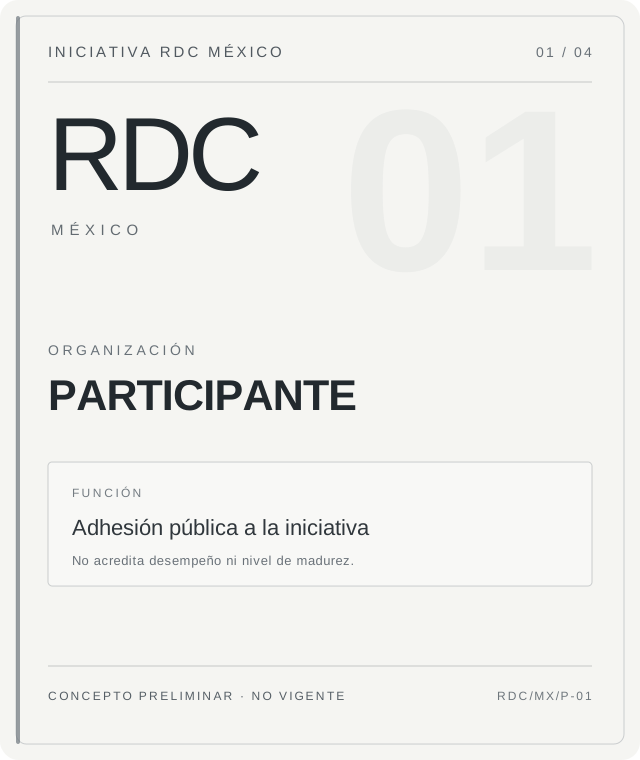
    • Organización participante
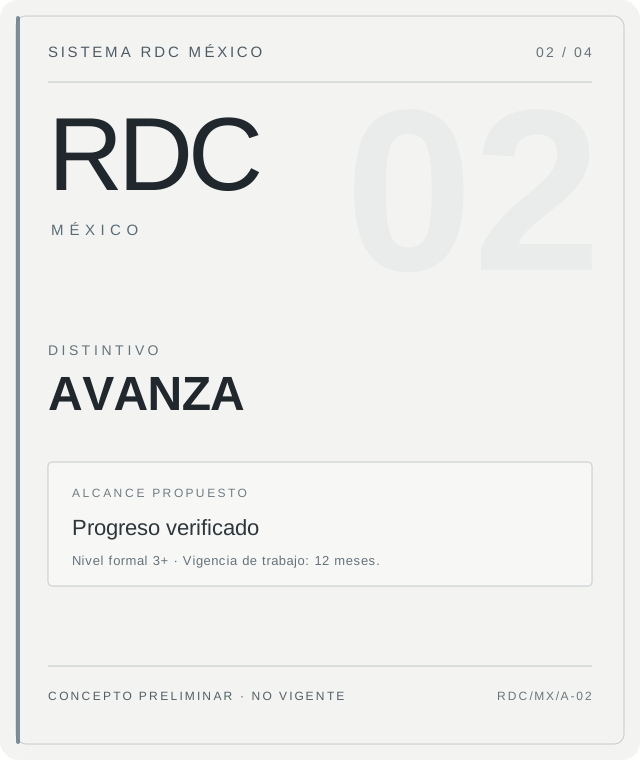
    • RDC Avanza
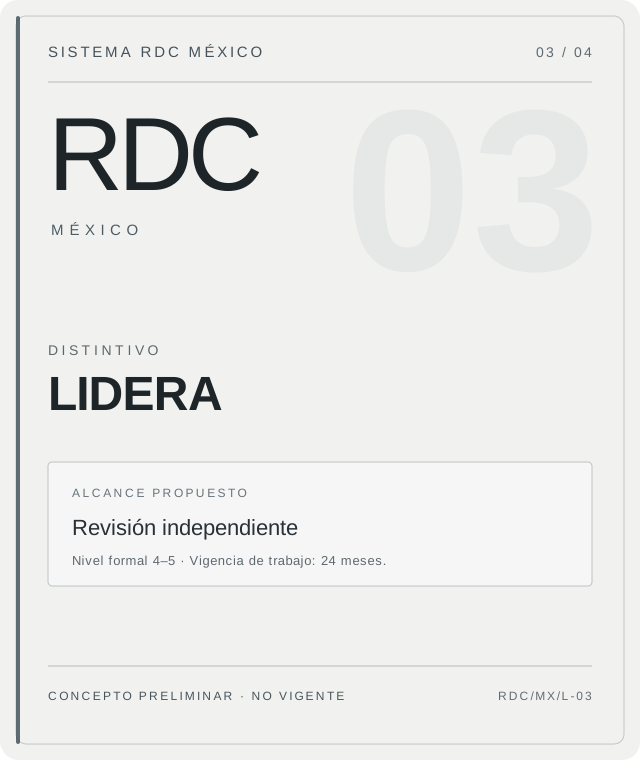
    • RDC Lidera
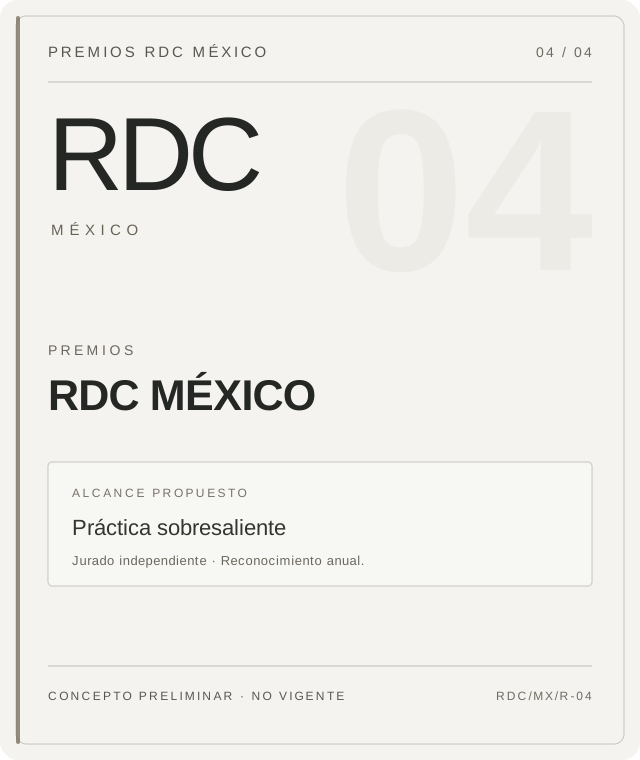
    • RDC Mexico Awards
    View recognition architecture

    Recognize journeys, not purchased reputation.

    Signature, maturity level, distinction and award serve different functions and must not be confused.

    • Organización participante: public commitment; it does not attest performance.
    • RDC Avanza: formal level 3 or above, verified progress and a proposed 12-month validity.
    • RDC Lidera: formal level 4 or 5, outcomes and independent review; proposed 24-month validity.
    • RDC Mexico Awards: an independent jury recognizes one outstanding practice and does not assess total maturity by itself.
    • Each distinction would have an identifier, validity, public record and withdrawal rules; it is not legal, regulatory or ISO certification.

Rules of the road

Credibility must be designed too.

  1. 01

    Independent

    No member, sponsor or authority controls the agenda alone.

  2. 02

    Transparent

    Visible methodology, criteria, funding and conflicts of interest.

  3. 03

    Separated

    Support, evaluation and recognition use independent decisions.

  4. 04

    Evolving

    Evidence, public participation and continuous improvement update the framework.

Recognition architecture

One family. Four different claims.

These visual studies are deliberately restrained working labels. They separate membership, verified progress, independently reviewed leadership and excellence in a specific practice without presenting themselves as active badges or recognitions.

Organización participante

Public commitment to the initiative. It does not attest performance or maturity.

RDC Avanza

Proposed for organizations at level 3 or above with reviewed progress and evidence.

RDC Lidera

Proposed for levels 4 or 5 with outcomes and independent review.

Premios RDC México

Recognizes one outstanding practice through a jury; separate from maturity.

Recognition architecture. Before use, the methodology, independent evaluation, validity, verifiable identifiers, public records and appeal, suspension and withdrawal rules must be approved.

Preliminary proposal · Open consultation

A starting point for building CDR adoption in Mexico.

The proposal turns a broad vision into an architecture that can be discussed, tested and improved: it defines who participates, five maturity levels and the rules under which RDC Mexico distinctions and awards could be granted.

  1. 01National multisector model
  2. 02Five maturity levels
  3. 03Evidence, distinctions and awards